
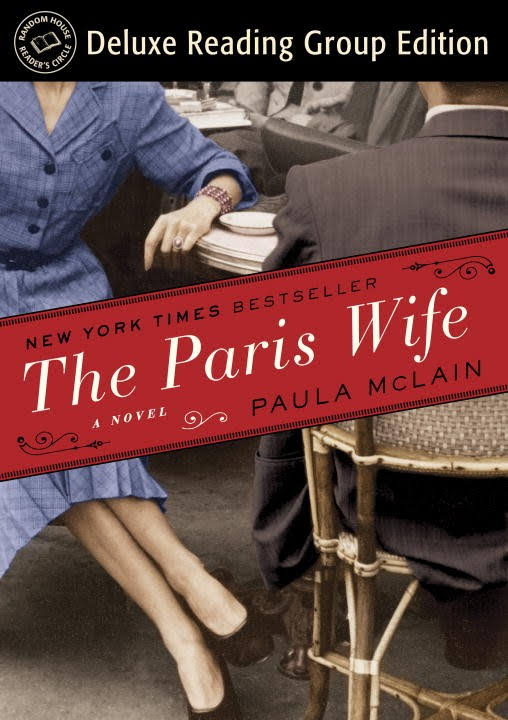
The Paris Wife is a fictional tale of the emotions surrounding Earnest Hemingway and his first wife, Hadley. Though Earnest’s own words and other texts were used to recreate documented events, the emotional accuracy can’t be verified. However, its not a stretch for me to believe this book captured things accurately.
Earnest and Hadley meet when he is 21 and she 29, so in an age where women were married quite young, typically to older men, they are not your typical couple. But as romantics like to believe love doesn’t follow any rules regarding age, social class or even gender, so there’s a certain magic to their story right from the beginning. These are two people who don’t like to be told what to do, how to act and certainly not who to love; how can you not root for them to succeed where so many others expect them to fail?
Even though I knew the outcome I still read this hoping I might be wrong. I suppose that’s because the story is primarily told from Hadley’s point of view, and she worshiped Earnest, hanging on his every word and finding happiness, even life, in his proximity. There are some people that just have that allure; the way they tell a story, the way they laugh, the way their eyes sparkle. You can become enamored with them because just being close gives you an energy you can’t produce on your own. I think Hemingway was like that, and Hadley wasn’t the only one to get lost in his shadow. But she was maybe the only person to see past it. Earnest was outwardly brave and boastful, but inwardly insecure, and Hadley seemed the only person to truly see this and understand it and love him for it all the same. And when that wasn’t enough anymore, I almost took it personally.
Hadley gave her entire being to Hemingway, and when she didn’t get that back I was angry and offended and even a little hurt. But I wasn’t just angry at the people who hurt Hadly, I was angry at her a bit too. Hadley is also outwardly strong and inwardly insecure, and not an angry person in general, but I wanted her to lose her composure and lash out. I wanted her to be inwardly strong and outwardly viscous, to take what was hers and shock the hell out of Earnest and everyone else who didn’t give her the credit she deserved. Whether because she was the older woman, the first wife, or the one who knew Earnest best, I wanted her to beat the odds, and decimate everyone who stood in her way. (That sounds a bit harsh if you don’t know what happened to her, but if you read the book I think you’ll agree with me). But beating the odds might have turned into her nightmare.
Its well known that Earnest Hemingway was a remarkable writer, but a less remarkable man. Perhaps that wasn’t his fault, but he seemed to generate both admiration and disdain among those he was closest to, and his attributes would never outweigh his flaws. Not for those closest to him. Not even for Hadley, who I suspect was probably the only person that may have come close to tolerating those flaws indefinitely. It was too much, and in the end I wanted her to be happy more than I wanted her to beat the odds.
I believe, as the book alludes, that she was literally suffocating before she finally broke free. I wouldn’t want her to live with the physical weight of her pain crushing her little by little each day, and I think life with Earnest would have been an endless cycle of suffocation. I think she would never be free to believe that the worst was over, and would live in constant fear of the next threat. I’ve had one minor bout with depression; I can’t imagine a lifetime of it, and I wouldn’t wish that on Hadley. (I do still wish she had lashed out though).
In the end maybe she was stronger than I gave her credit for.
 Michele Lenard